I'm so excited. The wool for The Boy's toga arrived yesterday. I ordered it from a website I'd never seen before, and shipping took a little over a week, which feels slow thanks to the ridiculously speedy delivery from Fabric-store.com I'm used to, but the result is so worth it. Fabric Mart Fabrics has a somewhat limited selection of fabrics (keeping in mind that I only want natural fibers), but the prices are ridiculously nice, and they take the time to describe not only the weight of the fabric, but how it drapes. There are suggested ideas of what to use the fabric for, but I don't know that they really pay attention to what they're saying, as they suggest making scarves out of gabardine.
I ordered this ivory wool crepe. It's gorgeous, lightweight and drapey, and extra wide which I didn't realize before. I'm looking forward to cutting it into it to make the curved edge, but I'm not sure if I should wash it or not. I'm worried about it shrinking and getting much thicker than it is now. The only piece of crepe I've worked with in the past got thick and felted after repeated washing, and I definitely don't want that for this wool.
I suppose I could cut the extra off first, and try washing the extra pieces to see how it washes up before deciding to wash it in the future. I need to test it, since I want to dye some of the fabric to make the stripe on the edge.
At least I have the giddy thrill awaiting me tomorrow of having a washer and dryer being delivered! For the first time since I moved to Oregon, I'll be able to do laundry in my own home!
On today's to-do list, aside from dishes, I need to figure out the classes I'll be teaching at Egils this year. I have had people ask if I'd teach how to french braid, and, although it isn't period, braided hair is better than a modern style. I'm also trying to figure out what I'm going to say for my more accurate hair styling class. I think it will be titled "Sewn Hairstyles, Yet Another Thing to Do with a Needle and Thread." Also on the Egil's front, some friends of ours, and their friends, will be joining us, making our own little camping group this year. We need to get land reservations in tomorrow, and get to figure out what equipment we have for cooking. It'll be exciting.
Ah well, lots to do today. At least last night I made a little progress on the Overly Ambitious Embroidery Project of DOOM! I finished the dark gold color last night. I need to go buy more skeins of thread, I'm running out of nearly every color.
Keeping Busy,
L
Wednesday, April 18, 2012

Monday, April 9, 2012
Saturday, April 7, 2012
Working on Fancy New Garb for the pair of us...
The Boy and I are getting "matching" garb. Since there's a chance we might be the next B&B, I've decided it's time to start working on our "potential investiture" garb for June. We decided to go Roman should the occasion arise, and even if it didn't, we'll have a nice set of Roman gear to wear.
So I'm sort of in the planning stages. I purchased some wool for a toga, and then decided to make up a list of garments I wanted to make, and a rough, totally overestimated budget for them. I've also be perusing period imagery and information sites, looking for the appropriate color combinations and styles that go with the thought of us being invested as territorial governors in Imperial Rome.
For Bastian I was planning to make:
So I'm sort of in the planning stages. I purchased some wool for a toga, and then decided to make up a list of garments I wanted to make, and a rough, totally overestimated budget for them. I've also be perusing period imagery and information sites, looking for the appropriate color combinations and styles that go with the thought of us being invested as territorial governors in Imperial Rome.
For Bastian I was planning to make:
Tunic- Linen with maroon clavi or bands, sleeves?
Toga-Wool with maroon band
Belt-Fabric, gold fringe?
Calcei-Leather, dyed dark red
We're also considering:
Subarmalis?-red linen, gold fringe
Breastplate?-plastic or leather with sculpted embellishments and painted
 |
| http://members.ozemail.com.au/~chrisandpeter/ radical_romans/male/tunic.jpg |
I'm contemplating how exactly I want to do the Tunic. I can't decide what the appropriate clavi (stripes on the tunic) would be for himself. The two narrow stripes on either shoulder indicate equestrian status, and I haven't found a source that says an equestrian class could become a provincial governor. There are two other clavi patterns repeatedly mentioned online, the senators wore a large stripe down the center of their tunica laticlava, and victorious emperors and generals got to wear the tunica palmate, a purple tunic with gold palm leaves embroidered on it. Clearly The Boy isn't a victorious general or emperor, so the palmate is out. I'm not a big fan of the way the senator's tunic looks with the single large stripe center front. But if it turns out you can't be a provincial governor without being a senator first, then that's the way we have to go.
I read once that the imperial purple was actually a reddish purple, like a maroon, though I can't remember where I saw it. Since The Boy got his PhD at a school whose colors include maroon, I thought it would be a nice touch. Himself will be more comfortable in a linen tunic, especially in June, and linen is a sign of wealth. I'm also not sure about sleeves. I think I want to do a short sleeve, give him a little more coverage on the shoulder.
 |
| http://www.dl.ket.org/latin1/things/holidays/halloween/togas.htm |
I've already purchased the wool crepe I intend to use for the toga. I found a good deal on fabricmartfabrics.com, $9.99/yard for an ivory crepe. I ordered 7 yards, and when I checked out, they gave me a surprise $2 off per yard, and with the shipping it came to less than $65! I plan to cut it to a half circle shape of the earlier Imperial togas, mostly to save money on buying fabric, and because it will be slightly easier to wear. See image 5 as the simplest style. I'm thinking of visiting Eugene Textile Center and dying the fabric for the clavi and the stripe on the toga to the maroon color.
The belt is pretty simple, a narrow width of fabric, red since Himself is a squire, with fringe. I like the look of gold fringe.
 |
| http://www.florentius.com/calcei-main.htm |
The calcei are Roman boots, made from leather with cut work that laces up on top of the foot with some ankle support. Romans wore boots when outside, and sandals indoors. The wealthiest Romans with slaves would have a slave to carry their sandals when they visited others. So The Boy and I both need boots as this will be an outdoor event. I'm also thinking about making these myself, because shoe making seems exciting, but this particular style requires a last, and I don't know if anyone in the area has a set. Roman culture has some guidelines for shoe color, and red shoes are reserved for the Patrician class.
 |
| http://employees.oneonta.edu/ farberas/arth/arth209/augustus.html |
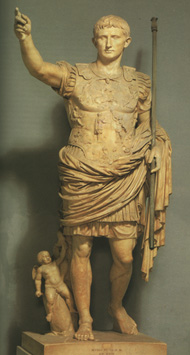
The garments we're considering for him, but aren't sure are the Subarmalis and Breastplate. They'd be an easy way to save money by excluding them. I want them because of the image of Augustus in his embossed breastplate and toga looks so mmmmmm! The combination of militaristic and oratory makes sense for me since Himself is both a fighter and a talker. If we do manage to get them done, I would make a light weight Subarmalis without all the padding since Himself wouldn't be fighting in it and wouldn't need it. I'm planning it from Crimson Linen from Fabrics-store.com with the pteruges (strips around the waist and shoulders) done in linen with bullion fringe at the bottoms. Theoretically, I'd buy a plastic breastplate that is fairly plain, and use Sculpty or something else to create the embellishments, and paint it in a bronze color.
And now for the parts that I'm wibbling on.
As for my new Garb I was planning to make/aquire:
Tunica interior-white linen, long sleeve
Over Dress-Egyptian style tunic? Gathered neckband? “tapered”?
Palla-silk? Linen? Patterned?
Belt?
Boots-leather, cutwork
Jewelry-moon necklace, two or three drop pearl earrings, coral necklace, bracelets, rings
 |
| http://www.touregypt.net/featurestories/ mport.htm |
I'm not sure exactly what I'll be making for myself yet, since I can't seem to pick a style. I know I want a new linen under tunic, the tunica interior which will be plain white and long sleeved. I might embellish the neckline with a little trim, but not much. I found a website with a bunch of Fayum mummy portraits, and I love the look of this lady. The blue and gold are a lovely combination. The ladies of Roman Egypt all wear colorful tunics, many in red tones, including one in bright pink! Most have clavi in a dark color, some with a thin gold edging to black bands. There is a large variety in their jewelry, but the metal all appears to be gold, and there is a frequency of pearls. Most of the necklaces are chokers, but there are a few with longer.
Alternatively, I could stick to the Roman styles I've been doing and do a sleeveless stola. There are a couple styles I haven't experimented with yet, specifically the banded stolla as done by Iohanna fillia Iacobi. http://www.flickr.com/photos/jenthies/842192722/in/photostream/
The banded style or one with the top gathered into shoulder straps are much more appropriate for a woman living in Roman Italy like my persona does. I'm not sure what colors I'm going to use yet, I haven't found a fabric I'm in love with yet, and there's not much in my stash that's calling to me. I have a metallic silk stola that I started ages ago that could be finished for this purpose, but because it is so see through I'd want a layer between stola and tunica interior. No idea on that yet.
Equally, I have no idea what I want to do for the palla. The fabric I'm currently using for a palla is a gorgeous gold silk sari with metallic threads woven throughout. But I'm getting a little tired of it. I'm not sure what I want instead, a linen or wool or silk, patterned or plain, maybe with fringe along the edges? The sash I'm using now is a brown and white silk, and it's fine, but again, I'm bored with it. I would love for this to be the opportunity to get something nicer, but I haven't really looked into it.
 |
| http://www.florentius.com/calcei-main.htm |
I also want to make myself a cute pair of Roman shoes to wear for this. The same Roman reenactor site that has the cute boots above has a pretty pair of women's shoes. I want to dye mine red also, because I wouldn't be the wife of a high ranking governor if I weren't high class myself.
I'm looking forward to making some of the jewelry for this outfit. I've found a little bit of information about the crescent moon pendant worn by many of the Fayum mummies, but I need to find out more. The little I know is that they are good luck charms against evil, and are likely devotions to Diana. They're very pretty, and I like adding little things to an outfit that make it more accurate. I also want to find the findings necessary to make the three drop pearl earrings that are very common in portraiture.
So those are my current thoughts on the fancy new clothes. I didn't realize I had so much more planning to do on my side. I suppose I just have to wait a little while for some fabric to speak to me.
Also, I have no idea what to do with my hair!
Tuesday, February 7, 2012
So I've added new items to the To Do List...
As I mentioned a little while back, The Boy and I are one set of the Baronial Candidates. I've decided to get started on fancy clothes now so if the time comes and Himself and I are chosen, I'm not scrambling as badly to get things done. It allows me to spend a little more money and a little more time planning and purchasing. Theoretically, if we were to step up, it would be at June Investiture, the Principality's step up. We're a little worried, because no clear communication has come down from the King and Queen. We don't know if there's any big issues going on that would take their attention away from this decision, but we're hoping they get their butts in gear soon.
Meanwhile I'm planning...
I'm hoping to do a big houppelande for The Boy, probably royal or dark blue wool, with either dagged sleeves, or bag sleeves, I'm not sure which because I want to do some pewter casting and make little falcon dangles to sew onto the left sleeve. However, I haven't really done enough research to make decisions on it yet. I'm not sure what underlayers I'll need, definitely a white linen undertunic and braies. I'm thinking I might need a linen cote or jupon, but I'll need to research 1380's german to be sure. I also don't know if I want the hose to be linen or wool. I'm leaning towards linen because it will be June after all, and The Boy and I are rather on the insulated side.
I've got a color scheme in mind right now, but I'm not sure about it, because I was thinking dark blue and bright red, but I've already done a linen blend houp in those colors. Maybe I'll do a set of bright yellow hose for him, so as to go with his coat of arms, but I'm not sure. Bright yellow hose, bright red belt, blue houp? So very primary. I have a "trade" in the works with The Wifey and her Boy. She has me making him a shirt to wear with his kilt at Gulf Wars this year, due in about a month. In return for doing the sewing, they are supposed to be hunting around at Gulf Wars for a fancy new Squires Belt that I can purchase. There aren't as many good merchants up here, and I won't be at any event that might before the potential due date of the fancy clothes. I know in the past I've found some pretties at War that fit my imagined Squire Belt.
I'm not entirely sure what I want to make for myself. I'm working(ish) on conflict checking my arms, and thinking about making a heraldic cote as my potential step up clothes. I'm not committed to this idea yet, because I'm not sure if the arms will pass. The blazon is nice and simple, but rather easy to conflict. Azure, a fox rampant sinister argent, in base a dancetty argent. Anything that looks like a dog conflicts with any other thing that looks like a dog. So my white dancing fox that looks left conflicts with any light colored dog on one foot looking left. Ah well...
Meanwhile I'm planning...
I'm hoping to do a big houppelande for The Boy, probably royal or dark blue wool, with either dagged sleeves, or bag sleeves, I'm not sure which because I want to do some pewter casting and make little falcon dangles to sew onto the left sleeve. However, I haven't really done enough research to make decisions on it yet. I'm not sure what underlayers I'll need, definitely a white linen undertunic and braies. I'm thinking I might need a linen cote or jupon, but I'll need to research 1380's german to be sure. I also don't know if I want the hose to be linen or wool. I'm leaning towards linen because it will be June after all, and The Boy and I are rather on the insulated side.
I've got a color scheme in mind right now, but I'm not sure about it, because I was thinking dark blue and bright red, but I've already done a linen blend houp in those colors. Maybe I'll do a set of bright yellow hose for him, so as to go with his coat of arms, but I'm not sure. Bright yellow hose, bright red belt, blue houp? So very primary. I have a "trade" in the works with The Wifey and her Boy. She has me making him a shirt to wear with his kilt at Gulf Wars this year, due in about a month. In return for doing the sewing, they are supposed to be hunting around at Gulf Wars for a fancy new Squires Belt that I can purchase. There aren't as many good merchants up here, and I won't be at any event that might before the potential due date of the fancy clothes. I know in the past I've found some pretties at War that fit my imagined Squire Belt.
I'm not entirely sure what I want to make for myself. I'm working(ish) on conflict checking my arms, and thinking about making a heraldic cote as my potential step up clothes. I'm not committed to this idea yet, because I'm not sure if the arms will pass. The blazon is nice and simple, but rather easy to conflict. Azure, a fox rampant sinister argent, in base a dancetty argent. Anything that looks like a dog conflicts with any other thing that looks like a dog. So my white dancing fox that looks left conflicts with any light colored dog on one foot looking left. Ah well...
Monday, January 23, 2012
First steps have been taken...
The Boy and I have thrown our "hats" into the ring for B&B as our current Baron and Baroness are stepping down this year. This is exciting, but we're both avoiding getting our hopes up. We moved into the barony only a year ago, and have been warned by everyone we asked prior to sending in our letter of intent that the area is rather insular, and it is unlikely that "foreigners" will be chosen. There is only one other couple running, and we're friends with them.
Yesterday we had the first Candidate Q&A. It was sparsely attended, but the questions posed to us were thought provoking. Everyone noticed that the two sets of candidates had extremely similar responses to questions. Aside from a question about the Sargentry, we seemed to be very knowledgeable, engaging and earnest. The Sargentry is a uniquely An Tiran thing, and it specifically belongs to the principality of the Summits. As far as we understand it, the Sargentry is a set of trials to prove the test taker to be knowledgeable in the variety of aspects of the SCA. The Baroness usually is the one that puts her seal of approval on a person in the trials. And then it gets confusing. A previous Baroness that I like very much and share a lot of similar viewpoints with, believes that sargents should be a short step away from becoming a Peer. I look at the variety of people that I know that are sargents, and I don't see that. I see people that are a rather long way from being a Peer. So maybe it's all in the interpretation of the individual Baroness, but I think that should I become Baroness, it's going to be a whole lot harder to become a Sargent. I want the possibility of saying, I support this person to the Peer circle considering them, and I want the position of sitting Baroness to back up my opinions.
Ah well. Reconciling the differences from here and elsewhere isn't always easy. North-westerners are weird. We're doing the best we can, and that's all that we can do.
Yesterday we had the first Candidate Q&A. It was sparsely attended, but the questions posed to us were thought provoking. Everyone noticed that the two sets of candidates had extremely similar responses to questions. Aside from a question about the Sargentry, we seemed to be very knowledgeable, engaging and earnest. The Sargentry is a uniquely An Tiran thing, and it specifically belongs to the principality of the Summits. As far as we understand it, the Sargentry is a set of trials to prove the test taker to be knowledgeable in the variety of aspects of the SCA. The Baroness usually is the one that puts her seal of approval on a person in the trials. And then it gets confusing. A previous Baroness that I like very much and share a lot of similar viewpoints with, believes that sargents should be a short step away from becoming a Peer. I look at the variety of people that I know that are sargents, and I don't see that. I see people that are a rather long way from being a Peer. So maybe it's all in the interpretation of the individual Baroness, but I think that should I become Baroness, it's going to be a whole lot harder to become a Sargent. I want the possibility of saying, I support this person to the Peer circle considering them, and I want the position of sitting Baroness to back up my opinions.
Ah well. Reconciling the differences from here and elsewhere isn't always easy. North-westerners are weird. We're doing the best we can, and that's all that we can do.
Saturday, January 21, 2012
Housebook Documentation....
Patterned after the Housebook Master:
A 1480’s German Dress

Lady Petronia Casta
mka Lorien Haigh
This Dress in History
This dress is based off several images from the Medieval Housebook, an impressive manuscript started in 1475 in southern Germany
The dress (kleid) features a very tightly fitted bodice with an odd pleated section on the stomach and center back, an extremely low cut neckline that shows off the undergarment (hemd) (Fig. 1), with lacing that crosses over the collarbone often from a decorative lacing jewelry piece sewn onto the dress, and a full, overly long skirt that pools on the ground, and trails behind some women in a train. (Fig. 2)
The Housebook Master isn’t the only artist to have depicted this style of dress, and there are a few variations in the style. Some images show the sleeves to be widely cut, and consistent in width from bicep to wrist or longer. (Fig. 3) The armscye of this sleeve is deeply cut on the back of the dress, causing the sleeve to cover the shoulder blade. (Fig. 4) The alternative version of the sleeve is three quarter length, and tightly fitted from the bicep to the middle of the forearm. It is usually shown with a cut away on the sleeve from hem to just above the elbow. The sleeve is then laced across the opening and the hemd’s sleeve. (Fig. 5)
The shape of the neckline varies a little from dress to dress, though the majority of them are a slightly rounded V-shape from the collarbone. There are a few higher, more rounded necklines, (Fig. 6) and some have decorative collars around the back or decorative bands all the way around the neckline. (Fig. 3) The dress is frequently worn with a belt, either to hold pouches, (Fig. 4) or used to hike up the extra long skirts for walking. (Fig. 2) Occasionally, the lifted skirts show off another garment below the outer dress, either a petticoat, or likely, and under dress that is fitted throughout the body. In one example, the under dress is checky patterned. (Fig. 2)
The hemd is usually only visible at the front of the neckline, but an couple images of peasant women in their hemds show a banded neckline, pleated only at the center front (presumably also the center back) and full long sleeves, loose or gathered into a band at mid-forearm (Figs. 7&8). The dress is most frequently worn with poulaines, shoes with pointed toes that can sometimes be extremely long. (Figs. 1, 2, 5, 6&7)
There is also some variety to the styles of headdress worn with this kleid, though they almost always worn over a pair of braids, drawn up over the head in front of the ears. (Figs. 1-5&7) (There are occasions of loose hair, but these are often scenes of saints, young women, or extremely casual.) With these braids is worn most commonly either a fringed cap (Figs. 1&2) (seen most often in conjunction with the large loose sleeves), or a wulsthaube, a peculiar German headdress of white or patterned fabric drawn tight over a bump along the top back of the woman’s head (Figs. 5&6). A narrow ribbon around the head that supports a fringe (called a gefranse) that drapes over the back of the neck was sometimes worn alone, (Fig 9) with a floral wreath, (Fig. 10) or some combination of other hats. A cap and neck fringe are in at least one image, (Fig. 4) the wulsthaube and fringe are pretty common for this style, (Figs. 5&9) and occasionally there are unique hats seen only once in imagery. (Fig. 11)
Historical Methods
I have found very little information on how this particular garment would have been constructed in period. Much of the construction information available is for either earlier or later garments and from other geographical regions, but from this information can be extrapolated to give an idea on how this dress was constructed.
Natural fibers are the only ones that existed in the 15th century. Wool and Linen were the most common fibers in southern German at the time, though some silk was available, and there are other varieties of bast fibers that would have been known. Very little linen survives from the medieval period, as plant fibers decompose more quickly than protein fibers. Wool fibers have a certain amount of stretch to them, and this would help produce a smooth fitted body, but a fabric with less give would be beneficial for the supportive nature of the bodice, like linen of moderate weight. The images of this dress show the fabric puddling in thick folds on the ground. This indicates a heavy, denser fabric, likely mid- to heavy-weight wool. The images from the Housebook don’t have much detail of the texture of the fabric, and most of the outer gowns have no pattern; the few images in color show a solid color garment. (Fig. 12)
Linen would be the most likely material for the hemd, as such a garment would need to hold up to both body dirt and oils and repeated washing. Colored images present the hemd as mostly white, though several are embellished with bands of other colors, and embroidery or beadwork.
Hand sewing was the only option for constructing garments during this period. Garments have been found in London, a little earlier than the Housebook Master was working, where the stitching has completely decomposed, leaving the impression of seam lines, indicating the predominate sewing thread of the period was linen (Crowfoot, Ritchard, and Staniland 151). Techniques for sewing wool from Hedby in northern Germany
The pleating at center front and back is cause for confusion. Knife pleats and box pleats are the most common forms of pleating in garments depicted in historical costume, but create a fairly flat pleat. Cartridge pleats and rolled pleats are less frequent and are used to create volume in the pleat. Cartridge pleats are intended to gather a large amount of fabric into a small space without creating a bulky seam, and makes the fabric spring away from the body. Rolled pleats are rare, and there is very little evidence that it was used before Victorian times, but it creates long tubular pleats and seems to be the method used to create the skirts in some Renaissance paintings, specifically Lucas Cranach’s 16th century German gowns (Leed). The dress appears to close center front, and a few images show center front lacing hiding behind the pleats.
What I Did
I decided to make this gown a little less than three weeks out from the event it debuted at, though I’d been considering the dress for over half a year before. I’ve used historical materials and techniques where I could, given the time crunch and a lack of available funds.
I was given a five-yard piece of wool coating as a thank you gift from friends. It is thick enough to create the beautiful folds when draped. It came to my possession as a chai-grey color, and, being in love with the teal color of the woman’s dress in Gotha Lovers (Fig. 12), I decided to dye the fabric. I began with some RIT dye, but it was insufficient to color the fabric to any real depth, so I purchased some Jacquard Acid dye. Neither of these is period, but the depth of color was my goal, and I have very little knowledge of period dyes. In the short amount of time I had, I chose the dyeing technique I had some familiarity with.
To line the bodice and sleeves, I used some medium weight blue linen that I had for another project. The dress is sewn with modern polyester thread for several reasons, but primary was cost and color, I couldn’t find a good color match in silk thread to justify it costing more. Lacing cord is supposed to be black silk I bartered for, but the thread has gone walkabout since the dress’s debut, and has been replaced (hopefully temporarily) by cotton embroidery floss. With no skill in casting jewelry, I purchased a modern necklace clasp and used it to create my lacing loops. The hemd is made from light weight white linen.
I decided to pattern myself for this garment, mostly to see if I could. I believe that in period at least one other person would be doing the patterning, and it would have made it easier, but my work schedule made meeting someone else difficult. Patterning the sleeves was an impressive bit of torture. I went through over a dozen incarnations of the pattern before settling on the one I have now, and I’m not entirely convinced its right. The technique is based off that of the Grande Assiette, where the armscye is cut deep in back, and has a gore set into the back seam to create the large circumference necessary without adding bulk to the upper arm of the sleeve. The sleeve is patterned with the seam running up the center back of the arm, as is correct for most period garments. The elbow opening follows the seam, but is asymmetric, as the sleeve is angled to reduce bunching in the elbow. The eyelets on the sleeve opening are done by hand, though they are bound with polyester thread. The cord for lacing is made by hand by pulling a chain stitch tight, though I didn’t use a crochet hook.
The deep neckline of the dress is rounded, which was uncommon, but necessary because I am not shaped like the small women of the time. The dress has been modified since the first wearing to open the neckline wider, since it seemed too narrow when first patterned. The bodice has fairly straightforward seams; waist seam at natural waist or even a little below, side seams run vertically on the sides, center back seam. The only unusual seam was the shoulder seams, which all appear to be to the back of the shoulder line. I chose to close the dress with hooks and eyes that run down the center front, which is boned with a piece of plastic cable tie. I believe the dress in period was either laced closed, or had hooks and eyes, but cannot document the hooks. I also cannot prove there was boning in the dress, but my large bust requires more support.
I only had enough fabric left after cutting out the bodice and sleeves to make two panels of skirt. I chose to cut a back panel and two fronts from this fabric. The pleated portion of the skirt is cut in one with the smooth sides. I carefully measured the width I needed for the pleats, measured down the necessary height difference of the pleats, added the width I needed for the smooth sections of the skirt, and drew a diagonal line from the end of the waist to the length of the hem, giving the skirt panels a tiny amount of flare. The small triangular wedge that was left was flipped upside down to create a narrow gore to add just a tiny bit more flare at the hem. I purposefully cut the skirt about six inches too long in the front, and twelve to sixteen inches long in the back to create not only the train, but also the fabric puddling on the floor when the skirts are unbelted.
For the pleating, I choose to use six rolled pleats each for the back and the front. Most of the images showed six to ten pleats across the front. I had seen the results of others’ cartridge pleating, and decided the pleats were too narrow and too many to be the best method for my pleats. I specifically choose to sew my pleated portion to the bodice of the dress by leaving the bodice whole underneath it. In every version I’d read about online, the seamstress had chosen to cut out the portion of the bodice where the pleating was, and inset the pleated panel. Doing that perplexed me, and one seamstress who had done it mentioned trouble with the pleats pulling apart under the strain of being such a tight fitted garment. By leaving the fabric whole as a background to sew the pleats to, most of the strain is off the pleats. My fabric tends to have more stretch to it than I want.
For the hemd, I drew up a cutting diagram and made the whole garment in about 12 hours. The shape is based entirely off the image of the peasant woman with sickle and shield. (Fig. 7) The center front and center back are gathered, and the whole neckline edge is bound. The armscyes are curved, but the sleeve is cut as a rectangle with no sleevehead. I cut the side seams at an angle, similar to the skirt panels, and inserted the resulting triangles as gores on the side seams to increase the width of the fabric. When I finished, I discovered that I hadn’t allowed quite enough room in the armscye, and the fit was too tight, so I added two small gussets to the armpits for more room.
With this dress I wear my fringed red hat, until I have time to make myself a wulsthaube. I wear cheap pointed toe shoes, because proper poulaines are expensive, and a belt to hike up my skirts so I can walk and dance. I’m looking forward to making a gefranse to wear over my hair on warmer days, and I hope to create something checky to wear beneath this dress, but need to do more research on whether that is a full under dress or simply a petticoat.
|
| Fig. 1 |
 |
| Fig. 2 |
 |
| Fig. 3 |
 |
| Fig. 4 |
 |
| Fig. 5 |
 |
| Fig. 6 |
 |
| Fig. 7 |
 |
| Fig. 8 |
 |
| Fig. 10 |
 |
| Fig. 9 |
 |
| Fig. 11 |
 |
| Fig. 12 |
Bibliography
Crowfoot, Elisabeth , Frances London : Museum of London
Gotha Lovers. (Fig. 12) Master of the Housebook. c. 1484. Schlossmuseum. Freidenstein , Germany
Jones, Heather Rose. "Archaeological Sewing." Heather Rose Jones. 29 Feb 2004. Web. 14 Jan 2012.
Lady with Letter Coat of Arms. (Fig. 1) Master of the Housebook. c. 1475/1500. National Art Collections Dresden Dresden , Germany
Lady with Radish Coat of Arms. (Fig. 2) Master of the Housebook. c. 1475/1500. National Art Collections Dresden Dresden , Germany
Leed, Drea. "Period Pleats." Elizabethan Costuming Page. N.p., n.d. Web. <http://www.elizabethancostume.net/pleats/>. 14 Jan 2012.
Lovers on Horseback. (Fig. 11) Attributed to Master bxg, active c. 1470-1490. <http://www.gluckliche-eme.com/15thcentury.htm>. 14 Mar 2011
Lovers with a Falcon. (Fig. 10) Master of the Housebook. c. 1480. National Art Collections Dresden Dresden , Germany
"Master of the Housebook (Getty Museum
Peasant woman with sickle and shield. (Fig. 7) Livelier than Life- The Master of the Amsterdam Amsterdam
/MH.PeasantWoman(LLcat81).jpg)
Playing Cards. (Fig. 4) Attributed to Master bxg, active c. 1470-1490. <http://www.gluckliche-eme.com/15thcentury.htm>. 12 Jan 2012
Standing Couple. (Fig. 5) Master of the Housebook. c. 1480. Staatliche Museen. Berlin , Germany
St Barbara and St Catherine. (Fig. 3) Master of the Housebook. c. 1485/1490. Rijksmuseum. Amsterdam , Netherlands
Woman with Two Children and a Blank Shield. (Fig. 8) Master of the Housebook. c. 1475/1500. Museum of Fine Arts , Boston Boston , Massachusetts
Young Couple. (Fig. 6) Master of the Housebook. c. 1480. Universitätsbibliothek. Erlangen , Germany
Young man and two girl (Fig. 9) Livelier than Life- The Master of the Amsterdam
/MH.YoungMan(LLcat66).jpg)
A&S Entries...
I'm working on getting my A&S docs up here for my winning! A&S entries. Which should go first, Housebook or Roman Hair?
Subscribe to:
Posts (Atom)