As I mentioned a little while back, The Boy and I are one set of the Baronial Candidates. I've decided to get started on fancy clothes now so if the time comes and Himself and I are chosen, I'm not scrambling as badly to get things done. It allows me to spend a little more money and a little more time planning and purchasing. Theoretically, if we were to step up, it would be at June Investiture, the Principality's step up. We're a little worried, because no clear communication has come down from the King and Queen. We don't know if there's any big issues going on that would take their attention away from this decision, but we're hoping they get their butts in gear soon.
Meanwhile I'm planning...
I'm hoping to do a big houppelande for The Boy, probably royal or dark blue wool, with either dagged sleeves, or bag sleeves, I'm not sure which because I want to do some pewter casting and make little falcon dangles to sew onto the left sleeve. However, I haven't really done enough research to make decisions on it yet. I'm not sure what underlayers I'll need, definitely a white linen undertunic and braies. I'm thinking I might need a linen cote or jupon, but I'll need to research 1380's german to be sure. I also don't know if I want the hose to be linen or wool. I'm leaning towards linen because it will be June after all, and The Boy and I are rather on the insulated side.
I've got a color scheme in mind right now, but I'm not sure about it, because I was thinking dark blue and bright red, but I've already done a linen blend houp in those colors. Maybe I'll do a set of bright yellow hose for him, so as to go with his coat of arms, but I'm not sure. Bright yellow hose, bright red belt, blue houp? So very primary. I have a "trade" in the works with The Wifey and her Boy. She has me making him a shirt to wear with his kilt at Gulf Wars this year, due in about a month. In return for doing the sewing, they are supposed to be hunting around at Gulf Wars for a fancy new Squires Belt that I can purchase. There aren't as many good merchants up here, and I won't be at any event that might before the potential due date of the fancy clothes. I know in the past I've found some pretties at War that fit my imagined Squire Belt.
I'm not entirely sure what I want to make for myself. I'm working(ish) on conflict checking my arms, and thinking about making a heraldic cote as my potential step up clothes. I'm not committed to this idea yet, because I'm not sure if the arms will pass. The blazon is nice and simple, but rather easy to conflict. Azure, a fox rampant sinister argent, in base a dancetty argent. Anything that looks like a dog conflicts with any other thing that looks like a dog. So my white dancing fox that looks left conflicts with any light colored dog on one foot looking left. Ah well...
Tuesday, February 7, 2012

Monday, January 23, 2012
First steps have been taken...
The Boy and I have thrown our "hats" into the ring for B&B as our current Baron and Baroness are stepping down this year. This is exciting, but we're both avoiding getting our hopes up. We moved into the barony only a year ago, and have been warned by everyone we asked prior to sending in our letter of intent that the area is rather insular, and it is unlikely that "foreigners" will be chosen. There is only one other couple running, and we're friends with them.
Yesterday we had the first Candidate Q&A. It was sparsely attended, but the questions posed to us were thought provoking. Everyone noticed that the two sets of candidates had extremely similar responses to questions. Aside from a question about the Sargentry, we seemed to be very knowledgeable, engaging and earnest. The Sargentry is a uniquely An Tiran thing, and it specifically belongs to the principality of the Summits. As far as we understand it, the Sargentry is a set of trials to prove the test taker to be knowledgeable in the variety of aspects of the SCA. The Baroness usually is the one that puts her seal of approval on a person in the trials. And then it gets confusing. A previous Baroness that I like very much and share a lot of similar viewpoints with, believes that sargents should be a short step away from becoming a Peer. I look at the variety of people that I know that are sargents, and I don't see that. I see people that are a rather long way from being a Peer. So maybe it's all in the interpretation of the individual Baroness, but I think that should I become Baroness, it's going to be a whole lot harder to become a Sargent. I want the possibility of saying, I support this person to the Peer circle considering them, and I want the position of sitting Baroness to back up my opinions.
Ah well. Reconciling the differences from here and elsewhere isn't always easy. North-westerners are weird. We're doing the best we can, and that's all that we can do.
Saturday, January 21, 2012
Housebook Documentation....
Patterned after the Housebook Master:
A 1480’s German Dress

Lady Petronia Casta
mka Lorien Haigh
This Dress in History
This dress is based off several images from the Medieval Housebook, an impressive manuscript started in 1475 in southern Germany
The dress (kleid) features a very tightly fitted bodice with an odd pleated section on the stomach and center back, an extremely low cut neckline that shows off the undergarment (hemd) (Fig. 1), with lacing that crosses over the collarbone often from a decorative lacing jewelry piece sewn onto the dress, and a full, overly long skirt that pools on the ground, and trails behind some women in a train. (Fig. 2)
The Housebook Master isn’t the only artist to have depicted this style of dress, and there are a few variations in the style. Some images show the sleeves to be widely cut, and consistent in width from bicep to wrist or longer. (Fig. 3) The armscye of this sleeve is deeply cut on the back of the dress, causing the sleeve to cover the shoulder blade. (Fig. 4) The alternative version of the sleeve is three quarter length, and tightly fitted from the bicep to the middle of the forearm. It is usually shown with a cut away on the sleeve from hem to just above the elbow. The sleeve is then laced across the opening and the hemd’s sleeve. (Fig. 5)
The shape of the neckline varies a little from dress to dress, though the majority of them are a slightly rounded V-shape from the collarbone. There are a few higher, more rounded necklines, (Fig. 6) and some have decorative collars around the back or decorative bands all the way around the neckline. (Fig. 3) The dress is frequently worn with a belt, either to hold pouches, (Fig. 4) or used to hike up the extra long skirts for walking. (Fig. 2) Occasionally, the lifted skirts show off another garment below the outer dress, either a petticoat, or likely, and under dress that is fitted throughout the body. In one example, the under dress is checky patterned. (Fig. 2)
The hemd is usually only visible at the front of the neckline, but an couple images of peasant women in their hemds show a banded neckline, pleated only at the center front (presumably also the center back) and full long sleeves, loose or gathered into a band at mid-forearm (Figs. 7&8). The dress is most frequently worn with poulaines, shoes with pointed toes that can sometimes be extremely long. (Figs. 1, 2, 5, 6&7)
There is also some variety to the styles of headdress worn with this kleid, though they almost always worn over a pair of braids, drawn up over the head in front of the ears. (Figs. 1-5&7) (There are occasions of loose hair, but these are often scenes of saints, young women, or extremely casual.) With these braids is worn most commonly either a fringed cap (Figs. 1&2) (seen most often in conjunction with the large loose sleeves), or a wulsthaube, a peculiar German headdress of white or patterned fabric drawn tight over a bump along the top back of the woman’s head (Figs. 5&6). A narrow ribbon around the head that supports a fringe (called a gefranse) that drapes over the back of the neck was sometimes worn alone, (Fig 9) with a floral wreath, (Fig. 10) or some combination of other hats. A cap and neck fringe are in at least one image, (Fig. 4) the wulsthaube and fringe are pretty common for this style, (Figs. 5&9) and occasionally there are unique hats seen only once in imagery. (Fig. 11)
Historical Methods
I have found very little information on how this particular garment would have been constructed in period. Much of the construction information available is for either earlier or later garments and from other geographical regions, but from this information can be extrapolated to give an idea on how this dress was constructed.
Natural fibers are the only ones that existed in the 15th century. Wool and Linen were the most common fibers in southern German at the time, though some silk was available, and there are other varieties of bast fibers that would have been known. Very little linen survives from the medieval period, as plant fibers decompose more quickly than protein fibers. Wool fibers have a certain amount of stretch to them, and this would help produce a smooth fitted body, but a fabric with less give would be beneficial for the supportive nature of the bodice, like linen of moderate weight. The images of this dress show the fabric puddling in thick folds on the ground. This indicates a heavy, denser fabric, likely mid- to heavy-weight wool. The images from the Housebook don’t have much detail of the texture of the fabric, and most of the outer gowns have no pattern; the few images in color show a solid color garment. (Fig. 12)
Linen would be the most likely material for the hemd, as such a garment would need to hold up to both body dirt and oils and repeated washing. Colored images present the hemd as mostly white, though several are embellished with bands of other colors, and embroidery or beadwork.
Hand sewing was the only option for constructing garments during this period. Garments have been found in London, a little earlier than the Housebook Master was working, where the stitching has completely decomposed, leaving the impression of seam lines, indicating the predominate sewing thread of the period was linen (Crowfoot, Ritchard, and Staniland 151). Techniques for sewing wool from Hedby in northern Germany
The pleating at center front and back is cause for confusion. Knife pleats and box pleats are the most common forms of pleating in garments depicted in historical costume, but create a fairly flat pleat. Cartridge pleats and rolled pleats are less frequent and are used to create volume in the pleat. Cartridge pleats are intended to gather a large amount of fabric into a small space without creating a bulky seam, and makes the fabric spring away from the body. Rolled pleats are rare, and there is very little evidence that it was used before Victorian times, but it creates long tubular pleats and seems to be the method used to create the skirts in some Renaissance paintings, specifically Lucas Cranach’s 16th century German gowns (Leed). The dress appears to close center front, and a few images show center front lacing hiding behind the pleats.
What I Did
I decided to make this gown a little less than three weeks out from the event it debuted at, though I’d been considering the dress for over half a year before. I’ve used historical materials and techniques where I could, given the time crunch and a lack of available funds.
I was given a five-yard piece of wool coating as a thank you gift from friends. It is thick enough to create the beautiful folds when draped. It came to my possession as a chai-grey color, and, being in love with the teal color of the woman’s dress in Gotha Lovers (Fig. 12), I decided to dye the fabric. I began with some RIT dye, but it was insufficient to color the fabric to any real depth, so I purchased some Jacquard Acid dye. Neither of these is period, but the depth of color was my goal, and I have very little knowledge of period dyes. In the short amount of time I had, I chose the dyeing technique I had some familiarity with.
To line the bodice and sleeves, I used some medium weight blue linen that I had for another project. The dress is sewn with modern polyester thread for several reasons, but primary was cost and color, I couldn’t find a good color match in silk thread to justify it costing more. Lacing cord is supposed to be black silk I bartered for, but the thread has gone walkabout since the dress’s debut, and has been replaced (hopefully temporarily) by cotton embroidery floss. With no skill in casting jewelry, I purchased a modern necklace clasp and used it to create my lacing loops. The hemd is made from light weight white linen.
I decided to pattern myself for this garment, mostly to see if I could. I believe that in period at least one other person would be doing the patterning, and it would have made it easier, but my work schedule made meeting someone else difficult. Patterning the sleeves was an impressive bit of torture. I went through over a dozen incarnations of the pattern before settling on the one I have now, and I’m not entirely convinced its right. The technique is based off that of the Grande Assiette, where the armscye is cut deep in back, and has a gore set into the back seam to create the large circumference necessary without adding bulk to the upper arm of the sleeve. The sleeve is patterned with the seam running up the center back of the arm, as is correct for most period garments. The elbow opening follows the seam, but is asymmetric, as the sleeve is angled to reduce bunching in the elbow. The eyelets on the sleeve opening are done by hand, though they are bound with polyester thread. The cord for lacing is made by hand by pulling a chain stitch tight, though I didn’t use a crochet hook.
The deep neckline of the dress is rounded, which was uncommon, but necessary because I am not shaped like the small women of the time. The dress has been modified since the first wearing to open the neckline wider, since it seemed too narrow when first patterned. The bodice has fairly straightforward seams; waist seam at natural waist or even a little below, side seams run vertically on the sides, center back seam. The only unusual seam was the shoulder seams, which all appear to be to the back of the shoulder line. I chose to close the dress with hooks and eyes that run down the center front, which is boned with a piece of plastic cable tie. I believe the dress in period was either laced closed, or had hooks and eyes, but cannot document the hooks. I also cannot prove there was boning in the dress, but my large bust requires more support.
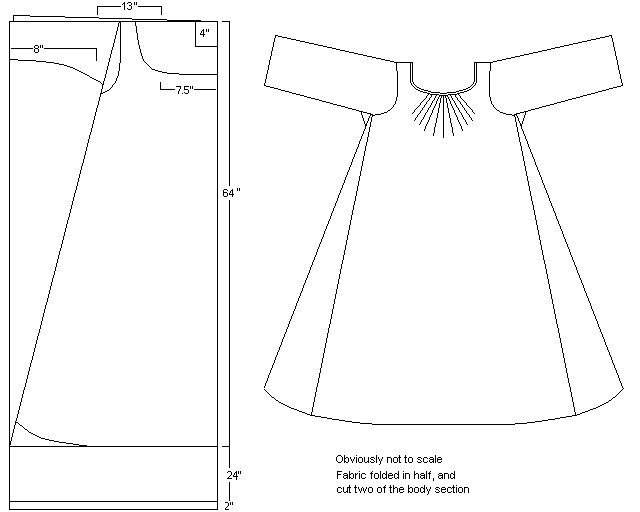
I only had enough fabric left after cutting out the bodice and sleeves to make two panels of skirt. I chose to cut a back panel and two fronts from this fabric. The pleated portion of the skirt is cut in one with the smooth sides. I carefully measured the width I needed for the pleats, measured down the necessary height difference of the pleats, added the width I needed for the smooth sections of the skirt, and drew a diagonal line from the end of the waist to the length of the hem, giving the skirt panels a tiny amount of flare. The small triangular wedge that was left was flipped upside down to create a narrow gore to add just a tiny bit more flare at the hem. I purposefully cut the skirt about six inches too long in the front, and twelve to sixteen inches long in the back to create not only the train, but also the fabric puddling on the floor when the skirts are unbelted.
For the pleating, I choose to use six rolled pleats each for the back and the front. Most of the images showed six to ten pleats across the front. I had seen the results of others’ cartridge pleating, and decided the pleats were too narrow and too many to be the best method for my pleats. I specifically choose to sew my pleated portion to the bodice of the dress by leaving the bodice whole underneath it. In every version I’d read about online, the seamstress had chosen to cut out the portion of the bodice where the pleating was, and inset the pleated panel. Doing that perplexed me, and one seamstress who had done it mentioned trouble with the pleats pulling apart under the strain of being such a tight fitted garment. By leaving the fabric whole as a background to sew the pleats to, most of the strain is off the pleats. My fabric tends to have more stretch to it than I want.
For the hemd, I drew up a cutting diagram and made the whole garment in about 12 hours. The shape is based entirely off the image of the peasant woman with sickle and shield. (Fig. 7) The center front and center back are gathered, and the whole neckline edge is bound. The armscyes are curved, but the sleeve is cut as a rectangle with no sleevehead. I cut the side seams at an angle, similar to the skirt panels, and inserted the resulting triangles as gores on the side seams to increase the width of the fabric. When I finished, I discovered that I hadn’t allowed quite enough room in the armscye, and the fit was too tight, so I added two small gussets to the armpits for more room.
With this dress I wear my fringed red hat, until I have time to make myself a wulsthaube. I wear cheap pointed toe shoes, because proper poulaines are expensive, and a belt to hike up my skirts so I can walk and dance. I’m looking forward to making a gefranse to wear over my hair on warmer days, and I hope to create something checky to wear beneath this dress, but need to do more research on whether that is a full under dress or simply a petticoat.
|
| Fig. 1 |
 |
| Fig. 2 |
 |
| Fig. 3 |
 |
| Fig. 4 |
 |
| Fig. 5 |
 |
| Fig. 6 |
 |
| Fig. 7 |
 |
| Fig. 8 |
 |
| Fig. 10 |
 |
| Fig. 9 |
 |
| Fig. 11 |
 |
| Fig. 12 |
Bibliography
Crowfoot, Elisabeth , Frances London : Museum of London
Gotha Lovers. (Fig. 12) Master of the Housebook. c. 1484. Schlossmuseum. Freidenstein , Germany
Jones, Heather Rose. "Archaeological Sewing." Heather Rose Jones. 29 Feb 2004. Web. 14 Jan 2012.
Lady with Letter Coat of Arms. (Fig. 1) Master of the Housebook. c. 1475/1500. National Art Collections Dresden Dresden , Germany
Lady with Radish Coat of Arms. (Fig. 2) Master of the Housebook. c. 1475/1500. National Art Collections Dresden Dresden , Germany
Leed, Drea. "Period Pleats." Elizabethan Costuming Page. N.p., n.d. Web. <http://www.elizabethancostume.net/pleats/>. 14 Jan 2012.
Lovers on Horseback. (Fig. 11) Attributed to Master bxg, active c. 1470-1490. <http://www.gluckliche-eme.com/15thcentury.htm>. 14 Mar 2011
Lovers with a Falcon. (Fig. 10) Master of the Housebook. c. 1480. National Art Collections Dresden Dresden , Germany
"Master of the Housebook (Getty Museum
Peasant woman with sickle and shield. (Fig. 7) Livelier than Life- The Master of the Amsterdam Amsterdam

Playing Cards. (Fig. 4) Attributed to Master bxg, active c. 1470-1490. <http://www.gluckliche-eme.com/15thcentury.htm>. 12 Jan 2012
Standing Couple. (Fig. 5) Master of the Housebook. c. 1480. Staatliche Museen. Berlin , Germany
St Barbara and St Catherine. (Fig. 3) Master of the Housebook. c. 1485/1490. Rijksmuseum. Amsterdam , Netherlands
Woman with Two Children and a Blank Shield. (Fig. 8) Master of the Housebook. c. 1475/1500. Museum of Fine Arts , Boston Boston , Massachusetts
Young Couple. (Fig. 6) Master of the Housebook. c. 1480. Universitätsbibliothek. Erlangen , Germany
Young man and two girl (Fig. 9) Livelier than Life- The Master of the Amsterdam

A&S Entries...
I'm working on getting my A&S docs up here for my winning! A&S entries. Which should go first, Housebook or Roman Hair?
Saturday, January 14, 2012
tonight is not the night for My Love...
Himself is supposed to be cooking a feast for today's Midwinter's Feast. That titular feast in fact. And tonight, after the last grocery run, the notebook with every scrap of information on the feast, has disappeared. For the last three hours, Himself has been driving around trying to find it, tearing the car and the house apart.
And right when he gave up hope and resigned himself to not finding it....
He found half the bread for tomorrow had gone moldy. He's now started baking. At 2:20am, when we need to leave the house at 8:30.
I'm of course not done with my A&S entry, but if I were, it wouldn't be a real entry would it?
Tuesday, November 22, 2011
Lorien is not too bright...
I had a break down over this sleeve because I couldn't figure out how to make the shorter side of the sleeve long enough to match up without distorting the lower portion of the sleeve. Then I realized that part of the triangular gusset was to accommodate the missing 2". Here is a poorly made paint image to let you know of my dumb.


Sunday, November 20, 2011
A&S Update...
So I've mostly settled on my A&S entries for Adiantum's competition in January. I'm torn between doing a reconstruction of Livia's hairstyle, and doing a research paper on the position of Ornatrices in Roman households. The former would be easier, because I've worked out how to accomplish the hairstyle already, my trouble would be how to flesh out the documentation to make it feel like it was worthwhile. On the other hand, I have very little actual research on the position of Ornatrices within a household, though I have done a little preliminary book searching. I mostly like the first option because of the visual aspect of doing the hairstyle is a little flashier, and I'm known in the area for hairstyling.
 The other entry I'm intending is my soon to be made Housebook dress. I decided to make this dress because my family has graciously given me tickets to go back to Texas for a visit at the beginning of December. I'll get to be home for Stargate's Yule, and was pondering whether or not to make something new, and was talking it over with my best friend. We both mentioned that the only dress we were interested in making at the time was the two different styles of dress that we would be wearing with the cute red fringed hats I made months ago. Since the styles were different, and the colors were different enough, I felt we wouldn't be too terribly twinkie, and we could go ahead with the plan. We've now challenged each other to make a fancy new dress, though The Boy thinks there should be a prize for the "winner." Her boy has promised to take us out for a drink.


 I've been working on it slowly, and most of the info is posted over at our shared blog. I've got the underdress, the hemd, done enough to wear, though I would like to hand finish all the seams before entering it in at Midwinter. I've included the inspiration image, which of course I can't find the actual citation at this moment, but came originally from Eme's Compendium. You also get a couple photos of me in my hemd and cute red fringed hat, and a lovely Paint sketch of my pattern for my hemd. It came out of about 4 and 1/3 yards of 3.5 oz linen from Fabric-Store.com, which I had originally bought back in February to make a smocked hemd for my Trossfrau. I've gotten the bodice patterned, but now need to figure out the sleeve pattern. I also got to use a fantastic local resource, the Eugene Textile Center, to dye the wool coating I was given as a thank you to a gorgeous teal color. The whole thing is coming along, but I have about a week and a half left to sew the whole thing together, if I allow time out because of travel to Seattle for Thanksgiving. I'm hoping it will all come together, but I think it will be okay.
Subscribe to:
Posts (Atom)